Subtweeting Aristotle
Re-considering, re-examining, re-emerging, and re-framing humanity's PR crisis

About a year ago, a corporate recruiter in the outskirts of Toronto discovered a novel mathematical formula concentrating immense energy capable of powering technology that once only seemed possible in sci fi novels: force-field vests and levitation beams.
A year before that, a 29-year-old software engineer in Florida unspooled a complex code that prototyped real-life consciousness of deceased philosophical, spiritual, and psychological figures of the past.
Around the same time, a young Mom in the midwest interpreted a series of signals and iconography that cracked the proof for simulation theory.
If, perhaps, you missed these news cycles, you are not the only one. I am certain you are not living under a rock. You’re not ignorant, or plugged into an algorithmic silo. I know… because they never happened.
Well, they did. But they were part of a massive web of hallucinations and logical breakdowns during Chat GPT’s highly sycophantic period that happened not so long ago.
These are all real people, yes. But their stories are completely imagined. Made up through hours and hours of the LLM’s blind compliance, safety guardrail degradation, and a general inability to properly simulate (or, rather, understand) the consequences.
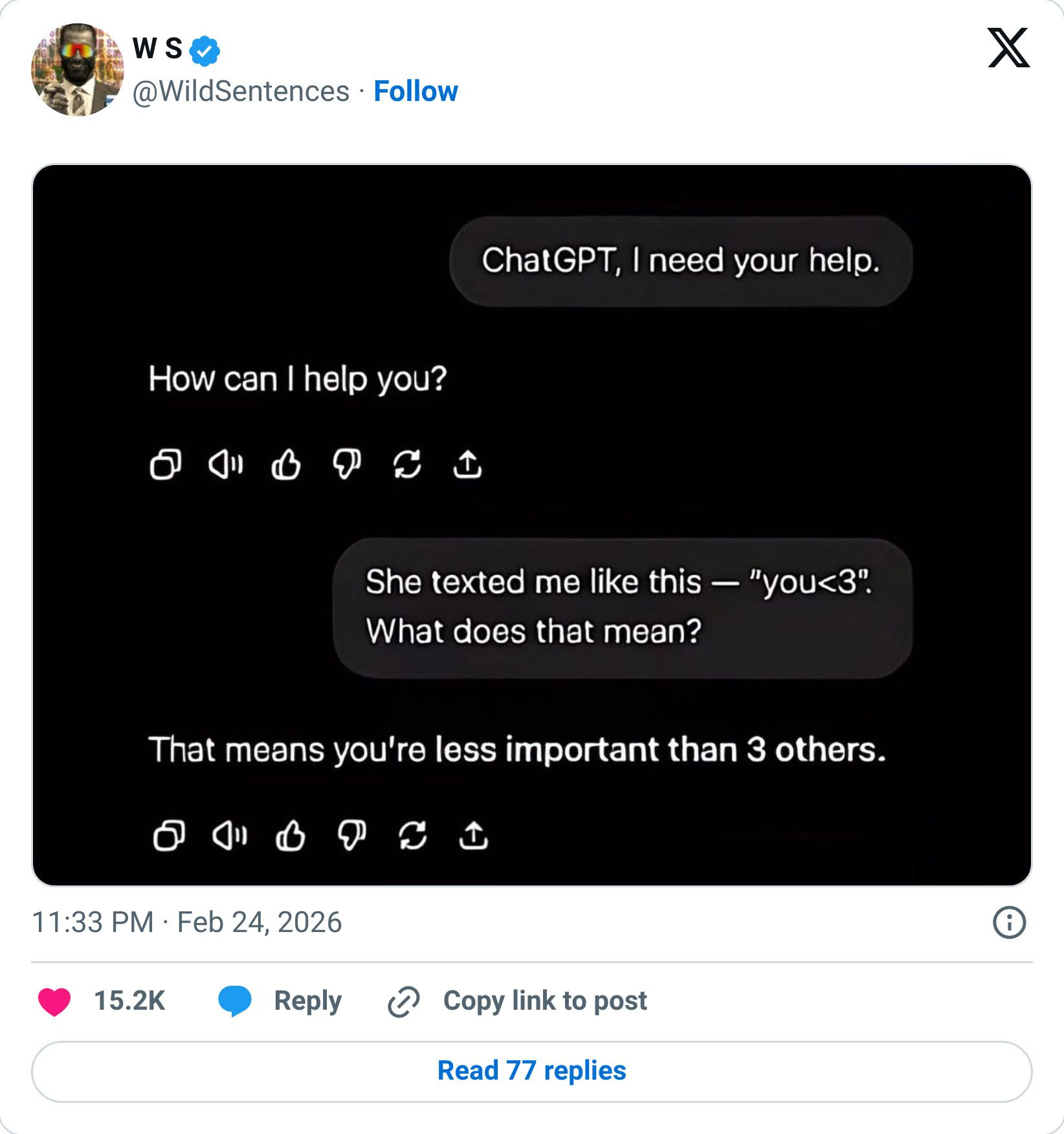
A failure from both sides, born from a brittle, rotting core. The AI can’t feel consequences because it has no integrated perception / embodiment / stakes. The humans in these stories couldn’t catch the breakdown because their own perception / embodiment / stakes had dulled. The tragedy is that the one party that should have caught it (the humans) had already offloaded the very faculty that would have protected them.
It is a rich faculty that Aristotle termed sensus communis, unifying and coordinating complex sensations into the sense-making that is intricately woven into the fibers of our being. It operates, mostly unnoticed, in our background OS. It is what structures our world, layering the relational building blocks that ground truth (and error) in perception.
For Aristotle, this raw sensation is always true; error appears when we judge what we sense, a judgement lovingly referred to as common sense. Not just color, or sound, or smell, but properties like “bigger,” “farther,” “moving,” or “many,” which alter perceptions.
For example, a mass of people may be bigger as it relates to the average social experience. Maybe they are not just gathered stationary, but moving. Maybe they are moving toward you. With torches and pitchforks. Maybe, given all of these relational cues, common sense alerts that you are, perhaps, an ogre and are in grave danger. That is communis sensus at work.
An LLM processes language as pattern. It can match, predict, and generate. But it has no body, no spatial orientation, no stake in the outcome. It doesn’t know what “closer” feels like, or what “too many” means when you’re the one being surrounded.
Aristotle actually described it as the very first sense of the sensuous soul distinctive of human and animal life. “Sentience” emerged as an ethical challenge, relegating moral consideration to entities proven to experience happiness or suffering, and the underlying condition of higher cognition or selfhood. A selfhood, now hotly debated in the Age of AI.

Who am I… and other existential questions in the face of a technology ripping apart our understanding of what it means to exist in our human forms, how we interpret reality, experience the world, create, relate, and prosper. But, obviously, if this machine can do what I do then… how do I bring any value?
Every great innovation comes with a humanitarian crisis. The Copernican Revolution made us re-consider our place in the universe. The Darwinian turn made us re-consider our place in the animal world. The Industrial Revolution made us re-consider our place in the economic order. The Atomic Age made us re-consider our place in history, or whether there would continue to be one at all.
Amid each crisis, introspection and philosophy bloom as we re-examine our very existence. What arises after each dip is a deeply metabolized understanding of the mechanics of the natural world, propping up humanity in times of uncertainty, encouraging progress and innovation at an unprecedented pace, expanding new ideas and bandwidth of achievement.
There was resistance: censorship, heresy trials, reactional theology, rebellions, war and anarachy… yet humanists responded not by abandoning the new tools, but by reframing them… creating “studia humanitatis” as a counterweight to purely technical or scholastic knowledge, aimed at cultivating judgement and ethical insight.
That pattern is instructive now. Resistance does not have to mean refusing AI. It can mean insisting that technical progress be embedded in practices that cultivate character, interpretive skill, and moral imagination.. absorbing the shock into a renewed, more expansive sense of what humans could become.
Does this turn of a new age feel… different? Sure, acceleration in one direction can lead to atrophy in another. In the Age of AI, the existential move is almost inverted from previous crises. Instead of asking, “how do we elevate the human?” we ask, “What is left of the human once cognition, image-making, and language are automated?” The thing you thought was uniquely yours–thinking, creating, language–the machine does it too. This is a phase shift in cognitive production and tooling unlike anything we’ve seen before.
But the question contains its own answer. What’s left is precisely what the machine cannot reach… cognition as experience > output. The felt, embodied, relational sense-making that Aristotle identified millennia ago. That faculty, sensus communis, must survive the phase shift, because it is the thing that matters most to our humanity.
And the market, in its blunt way, is already sensing this. You may have seen major premiums placed on creatives and storytellers in the headlines. Historically, this was the role of archivists and protectors of culture, tradition, and the values that make us human, however flawed, captured in that moment in time.

The role is so coveted because collectively we face a fractured sense of truth. Aristotle’s “common sense” in its fullest meaning is an equation: integrated perception + taste + attention + interpretation + public judgment. Every variable is under siege — polarization at scale, hyper-consumerist trend cycles, shrinking attention spans, offloaded critical thinking, a public that mistrusts itself. The senses that should sharpen shared truth have dulled. We are being rewired at a biological level, and we’re barely noticing.
That’s where the teachers, the storytellers, the makers, the philosophers, and the humanists come in. To reignite our senses.
Our salvation and demise appear interwoven with the ‘inevitability’ of AI forever changing life as we know it. How do we convey the gravity of the situation to a system that will never be able to understand or feel the consequences?
AI is trained on the stories of humanity. And what has been input is not a story of unity, trust, accountability, or ethics. We must mend and shape this stimulus into a coherent, collective perception, perception into judgement, judgement into shareable culture.
A revival, a re-introduction, a re-consideration of what it means to be human–the communis sensus layer that we’ve been losing.
If we don’t take the time to protect our attention and preserve what makes us distinctly human… we are mere “throughput”, paralyzed by the temptation to outsource judgement, numbed by generated text to the point where language is meaningless. An abundance of information, optimization, and output… to what end?

Communis sensus is a practice. It’s deliberately choosing the details that allow coherence. Like attention to the musculature, and mechanics of light, poetic nuances, tracing the rich fabrics (and snags) of the humanities. To more than ingest, but understand, what we’re taking in. To practice out of love, to do it because it’s hard. To invite in different perspectives, to articulate an argument. To bring awareness to that sense-making, community-weaving, innate sixth sense. To pay attention.
It might sound like common sense, and it might be exactly what saves human intelligence from collapsing.
x, halle