When being watched...
Just act normal, this is all totally normal...

“Now, rest one palm on your chest and one on your belly and breathe normally…”
Breathe…. normally?
After maneuvering through unnatural positions in a 99-degree room and collapsing to the floor like a corpse, you want me to command all of my attention to the organs in my center and just…. act…. normal?
In gas stations, and parking lots, and supermarkets, and crosswalks, I know I am being watched, and 99% of the time I am not even vaguely aware of it. But here, in this yoga studio, surrounded by sweating, smelling yogis, I am profoundly cognizant.
I’ve lost all sense of what a “normal breathing” pattern should look, sound, or feel like. My source of vitality is now a performance—what’s my cue again? Oh yes, “inhale.”
In this moment where all of my attention zeroes in on breath, my whole body awareness shifts. This looming, omnipresent ‘gaze’ is not isolated to the individual, however—when it lands on a crowd, the whole perceptual field shifts.
A watchful eye serves as an incredibly potent social cue. At Newcastle University, researchers installed “WE ARE WATCHING YOU” posters next to bike racks on campus that had chronic theft problems. No security cameras, no neighborhood watch, just the imagery of eyes and the proximity to being surveilled led to a drop in bike theft by 63% over the following year.
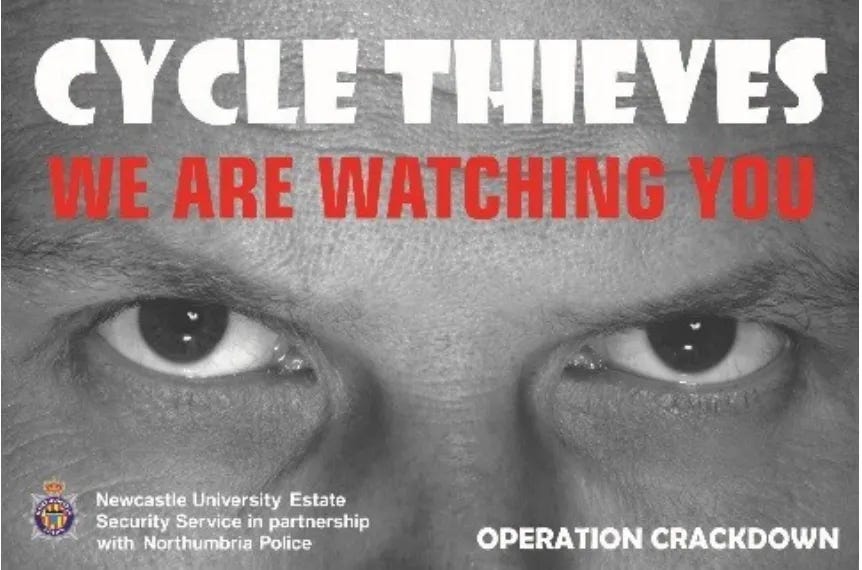
This ‘big brother’ phenomenon, once a single, obvious camera, has evolved into a mesh of sensors, apps, and platforms watching not just what you do, but how you do it, with every click, pause, track and hover that feed into a whole attention economy built on a behavioral database that you fuel.
Today’s big brother works for the state, certainly, but also the corporations and advertisers that watch your patterns to reveal things you never explicitly revealed… to sell things you never knew you needed… to those dark, desirous corners of yourself you didn’t know you had. At least not until that ad for “upper hair removal” or “6-week booty lifting bootcamp” landed in your sightline.
While I couldn’t find one single “surveillance index”, there were a few metrics that demonstrated how steeply we have climbed into a surveillance state:
Physically → see the global video surveillance market more than doubling, from $40-$44B in 2019 to $80B in 2025, with more near-real-time identification happening to nearly any citizen (a grossly overstated measure for any real ‘security’ purposes… but rather signaling population-scale tracking infrastructure).
Digitally → cookie blocking and opt-outs give users the psychological curve, but there are still dozens of different behavioral and technical signals that can be stitched together to track you with high confidence. A study from The Electronic Frontier Foundation found that around 83-84% of browsers had an “instantaneously unique fingerprint,” meaning they could be singled out in a crowd based on their config alone. More recent work has pushed fingerprint uniqueness above 99% in some setups.
Think you fall in the 1%? Don’t worry, event-level behavioral data can still place you to an audience or persona even if they can’t specifically name your unique digital fingerprint.
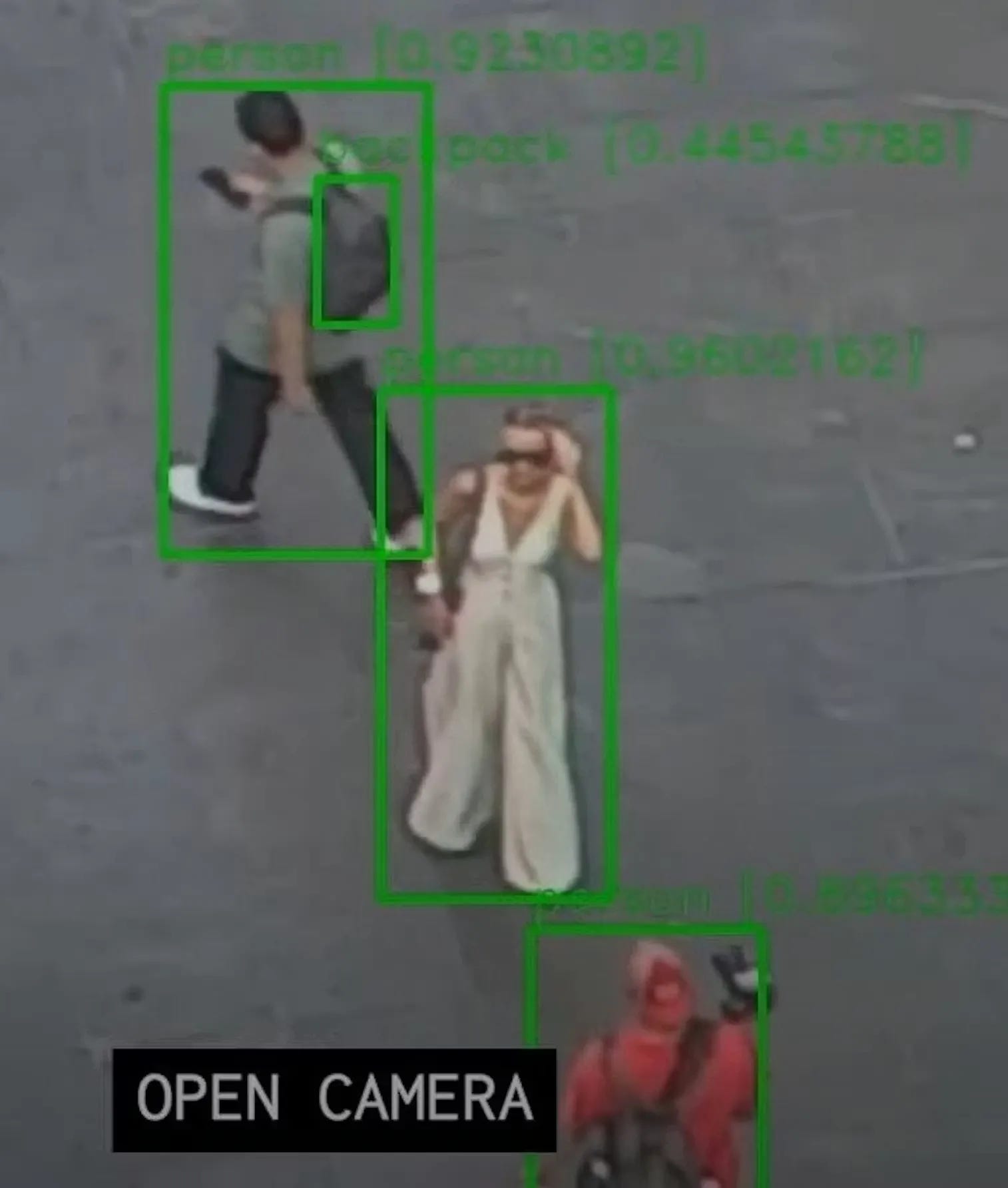
An artist in Belgium, Dries Depoorter, intercepted the space where digital and physical surveillance meet in a project called The Follower. He proved not just what’s technically possible, recording from open cctv cameras and scraping Instagram photos tagged within locations to identify individuals through the open camera images, but **what we’ve come to accept as normal (**almost to the point of negligible) in our lives.
The jump from “this is an art project” to “this could be done at scale by anyone with budget and motive” is demonstrably small.
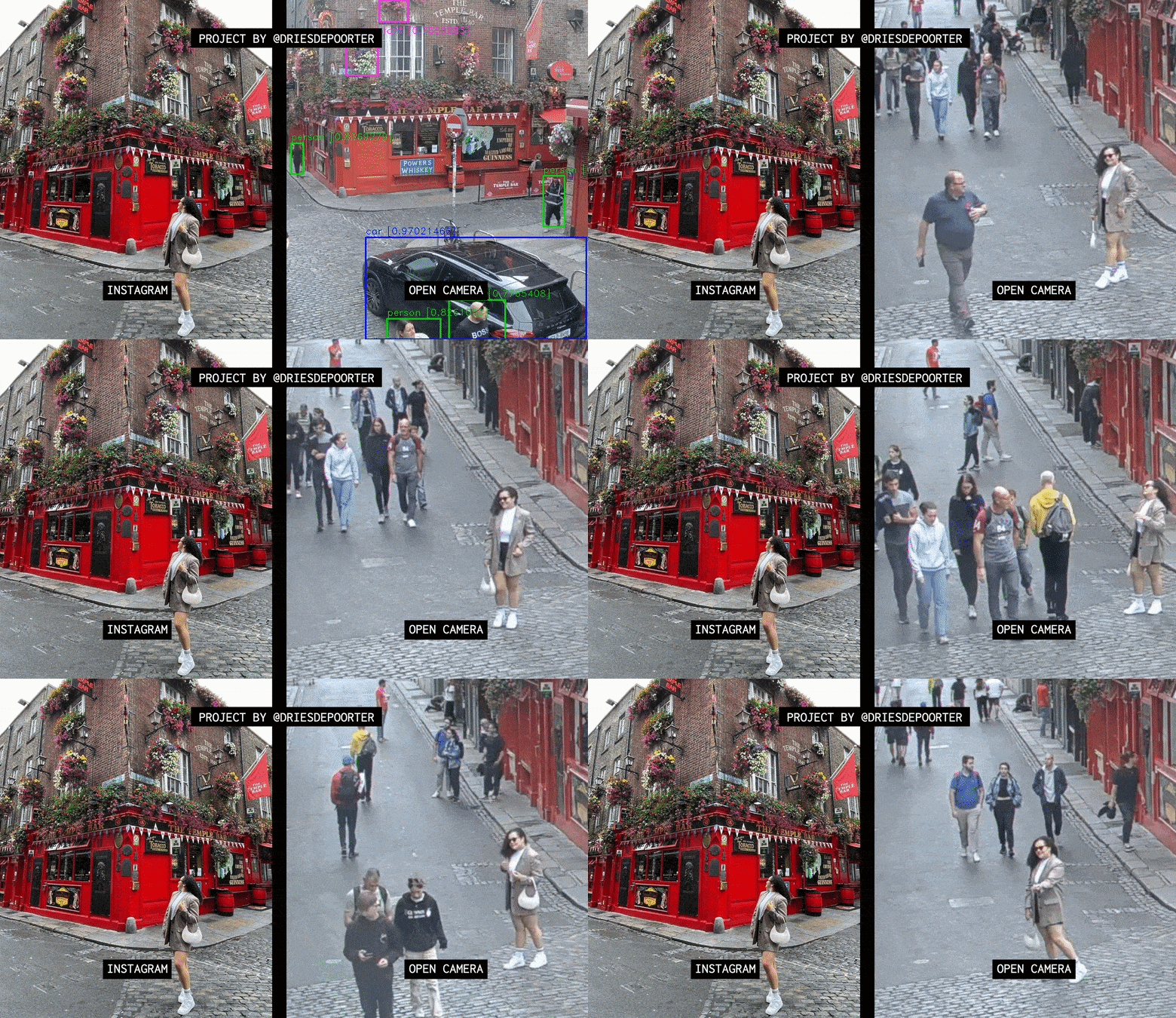
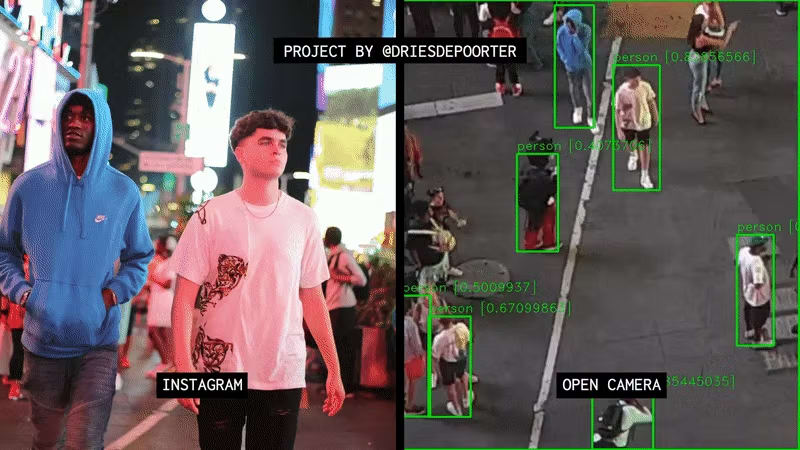
The Follower treats the modern surveillance stack as raw material to quickly and conveniently identify personal information of random passerbys. But until that notification to “share location” pops up, or a childhood address appears from a simple google query, or the terms & conditions are quickly exited out of… until then, that gaze is invisible. Its built into the way networks, apps and platforms are designed and the only way to function is to “opt-in”.
When Depoorter was confronted about his tactics, his defense was simply: “Yes, but they posted the picture also.”
That’s the everyday ideology of surveillance capitalism that we’re so familiar with synthesized to its core: posting = consent for any subsequent use, including ones the poster never imagined.
When you’re being watched—or even think you’re being watched—your brain quietly re-allocates resources: it sharpens its social radar, ramps up arousal, and spends extra effort managing how you come across. That mental energy being directed toward “audience management” is cognitively taxing. For example, we see this via social vision which becomes increasingly quicker at detecting faces when the individual is aware of being surveilled. The cameras, even the assumption or appearance of cameras, set us physically and cognitively on edge.
Our pupils dilate, vigilance heightens, and muscles tense when the brain diverts attention to: “what do they think of me?”
This invisible audience does shift behavior toward norm-following and self-censorship, sure. But it can over time erode the psychological space needed for experimentation, dissent, or just being… whatever it is one is when left unsupervised.
The self-awareness that peeks out in public discourse, meme-ifying epistemic anxiety and using humor as a coping mechanism, signals a cultural shift. An understanding of, and deep familiarity with, the ubiquitous surveillance machine.
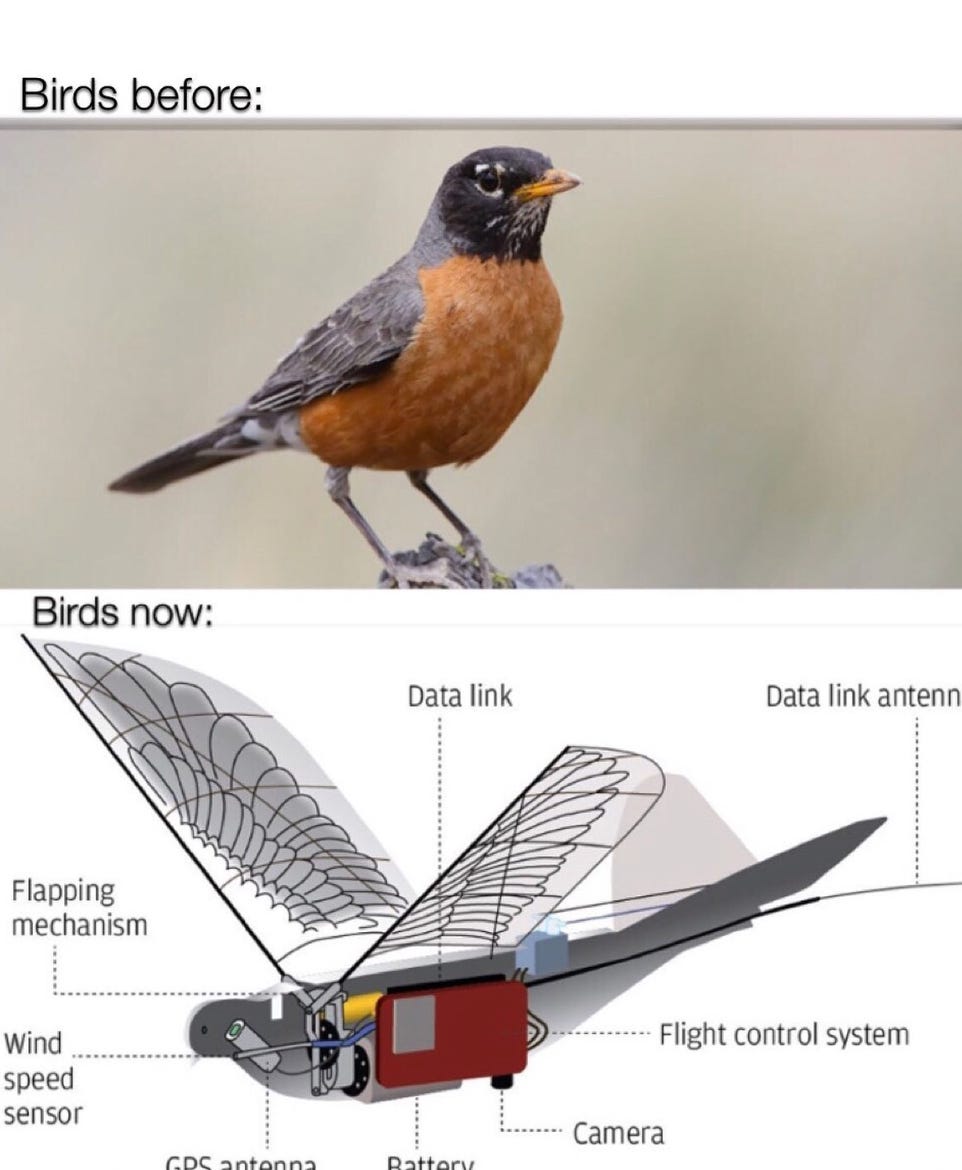
Now, imagine… an alternative that harnesses all of the powerful, granular human behavior insights that advertisers and governments wield to direct our attention toward their motives and make it more… self-serving?
Self…surveilling? When you self-track with tools you choose, for goals you set, the same mental systems that get hijacked by external surveillance can become scaffolding for change, which in the current system can feel almost… impossible.
Perhaps you’d like to change your screentime, or relationship with technology generally? Perhaps the nostalgia of a time before pocketable computers is on the mind, a time before sharing, and posting, and liking, and putting things in tiny shopping carts, and clicking “buy now”? Perhaps its an itchy, prickly feeling that shivers with the thought of an audience witnessing everything (yes, everything) you do?
But, flip the script on attention politics altogether, and that invisible audience becomes you. Your future self and your values, your motives, your identity, your model… yours.
Without sacrificing the technology that enables you to take a joy ride down the information highway or connect with humans around the world. Without crawling into a bunker and going ‘off the grid’. In this alternate surveillance universe, attention and metrics are used to guard your personal finite cognitive resources. To shift the locus of control. To not rent access to your data via a monthly subscription fee, but to own it. Or at least to give you a choice in the matter.
Leave a comment if you made it this far! I want to hear if you think birds are real or government drones. 📹
x, halle